
Anthropic shipped Fable 5.1 yesterday, and after two days of running it head to head against Fable 5 on identical workloads, I’ve landed on an uncomfortable conclusion: it’s the best model the company has released, and most heavy users will pay more for it, not less.
The basics first. claude-fable-5-1 carries a 1M token context window, 128K max output, and pricing of $10 per million input tokens against $50 per million output. Cache reads dropped 75% to $0.25/MTok. Stack that on the capability jump and the announcement reads like a giveaway. The math on real tasks tells a different story.
The cache discount is real. The bill isn’t.
Start with what works. Long agentic sessions re-read the same context dozens of times, so the cache price cut is genuinely transformative there. I re-ran a documentation crawl I’d first benchmarked around Fable 5’s launch, and the cached-input portion now costs roughly a quarter of what it did before.
Then output happened. At the default “high” effort setting, adaptive thinking runs constantly and can’t be switched off, and on hard agentic jobs Fable 5.1 produced about 1.7 times the output tokens of Fable 5 doing the same work. Output costs five times what input does. Run those numbers and my net cost per task came out higher despite the discount.
The same pattern shows up on subscription plans, which is what casual readers won’t get from the launch post. Max plan users are exhausting 5-hour session caps in 10 to 20 minutes on heavy coding runs, and weekly limits feel tighter than they did last week. Anthropic reset usage on launch day, which softened the first 24 hours and solved nothing going forward.
Latency is the smaller annoyance. Always-on thinking makes trivial tasks slower than they need to be, so I’ve kept lighter defaults for quick edits. Fable 5.1 is a scalpel, and Anthropic is handing it to everyone as the default.
Fewer refusals, tighter rails
The safeguard changes are the honest win here. Cyber false positives dropped 60% and biology and medical fallbacks fell roughly 85%, and my own testing backs both numbers up. Benign vulnerability-discovery prompts that bounced off Fable 5 now complete cleanly, and conversational pushback is noticeably rarer. For security researchers, that alone justifies the switch.
What nobody emphasized is that the rails moved in the other direction too. Claude Code made Fable 5.1 its default model and shipped stricter “Containment Escape” rules for auto mode. Credential handling, outbound connections, and external reads now require confirmation or get blocked outright. Your agent got smarter and less autonomous at the same time.
Migration from Fable 5 takes real code changes. Forced tool use now errors instead of cooperating, and thinking blocks are tied to the model and get invalidated the moment you edit an earlier turn in a thread. The platform docs spell out three breaking changes, and most teams I’ve watched work through them are patching with tool_choice: "auto" and restarting agents fresh rather than resuming old sessions.
One quiet addition almost everyone missed: every text output now carries a statistical watermark, and generated files get C2PA credentials through the Files API. Provenance infrastructure shipped inside a coding release with barely a sentence spent on it.

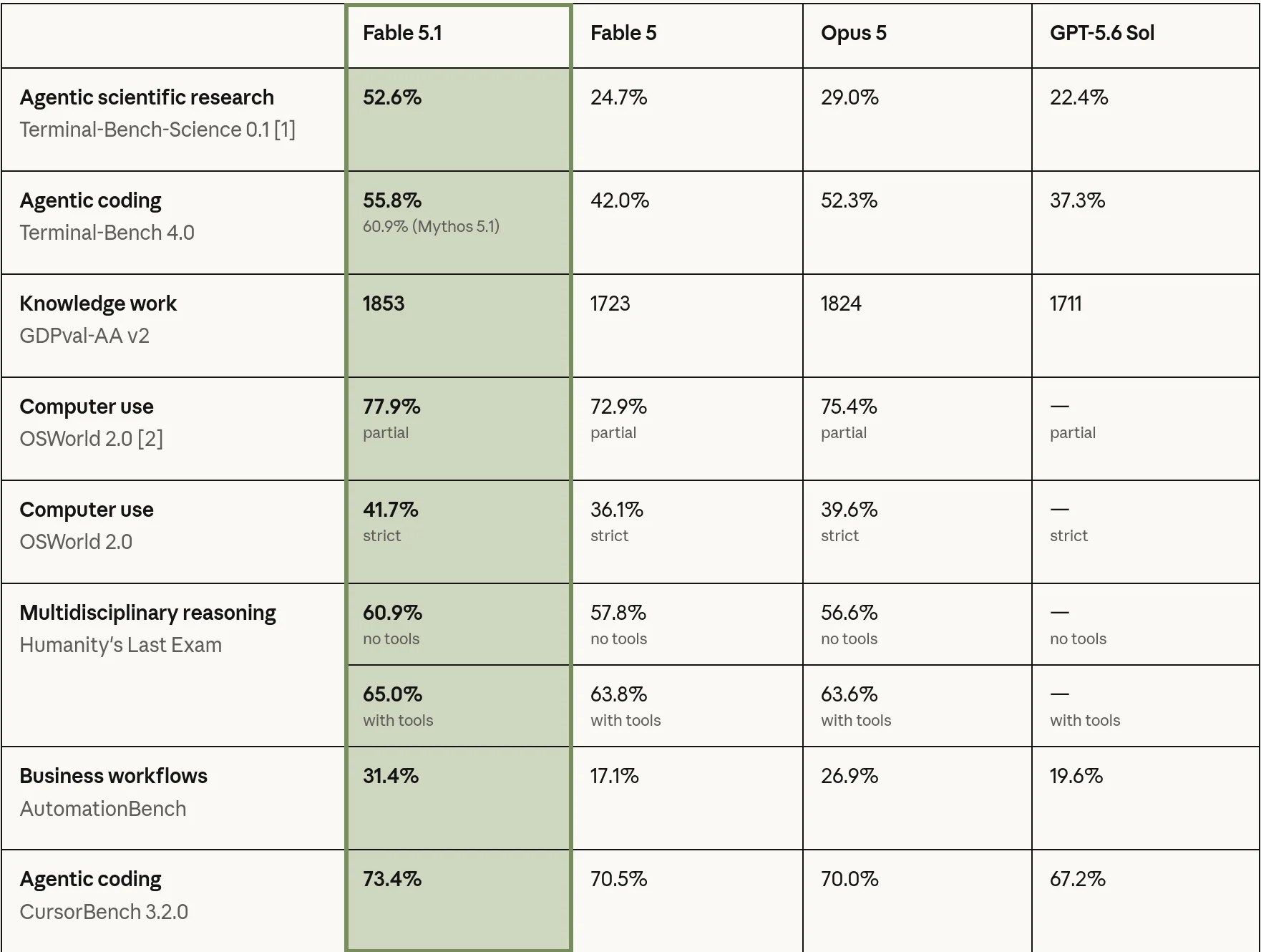
The Mythos split is the real story
Fable 5.1 and Mythos 5.1 are the same underlying model. Mythos keeps the full cyber and bio capability set and stays locked to vetted partners under Project Glasswing. Fable is what everyone else gets, with refined safeguards bolted on. That’s capability gated by customer rather than by version, and it’s the most consequential idea in the release even though it got the least airtime.
The fine print reinforces it. Fable 5.1 is designated a “Covered Model” with extra data retention and safety review policies, US-only inference costs 1.1 times list price, and full zero-retention safeguards are promised for fall. Meanwhile the pre-release artifacts, a custom GPU optimization and a high-resolution Venus map reconstructed from existing photos, hint at where Anthropic thinks this goes: less chatbot, more research collaborator.
My verdict: upgrade now if you pay per token and lean hard on caching, or if refusals were burning your time. Wait if you live on a Max plan doing agentic coding all day, because Fable 5.1 will chew through quota that Fable 5 treated gently, and no discount offsets a cap. If the premium stings, there are cheaper alternatives to Claude Sonnet 5 worth a look. The model is better, full stop. The open question is whether better is supposed to cost more, or just burn faster.