DLSS has always been a performance tool. NVIDIA’s AI took a game’s low-resolution frame and rebuilt it at higher resolution, giving you smoother gameplay without a pricier GPU. DLSS 5, unveiled in March and reaching games this week, breaks that pattern: instead of reconstructing what the renderer drew, it generates new lighting, materials, and detail the renderer never drew. That single shift is why a graphics feature became gaming’s loudest argument of 2026.
To understand the fight, know what changed. The DLSS suite already includes Super Resolution for upscaling, Frame Generation for inventing extra frames, and Ray Reconstruction for cleaning up path-traced light. All three approximate something the renderer intended to draw. DLSS 5, officially called 3D-guided neural rendering, sits on top of a finished frame and enriches its appearance, which makes it closer to a generative image model than an upscaler.
How the tech actually works
The pipeline starts normally. The game engine renders a conventional frame with rasterization or ray tracing, geometry, textures, and whatever lighting the developers could afford. That finished 2D color image, plus motion vectors describing how objects move between frames, gets handed to the neural model. NVIDIA has clarified the model never sees 3D geometry, depth, or texture data directly. It infers what it’s looking at, a face here, wet pavement there, from the pixels alone.
What runs next is a compact one-step diffusion transformer, distilled from much larger models so it fits inside a real-time frame budget on RTX 50-series Tensor Cores. It’s deterministic and causal, one frame in and one frame out, because nondeterministic AI flicker would be unwatchable mid-match. Training used renderer-derived attributes like albedo and normals as supervision, which anchors the output to the authored scene instead of letting it drift.
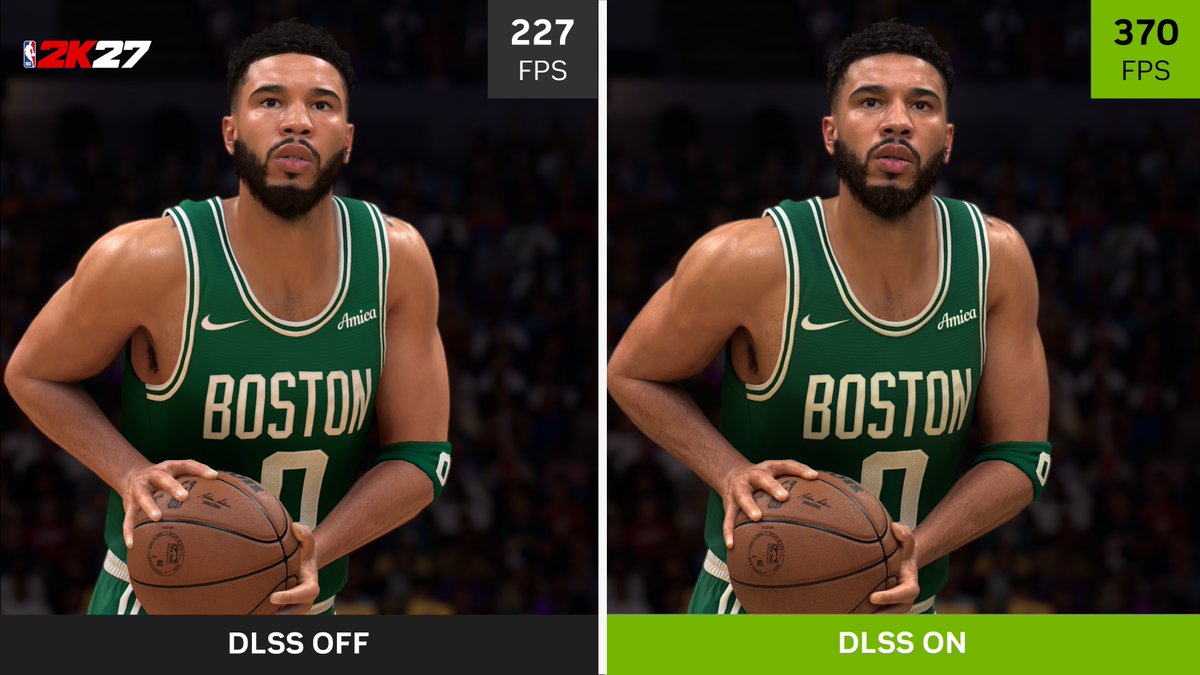
The cost is real, and it inverts what DLSS normally does. Examples have shown performance drops around 50 to 60 percent, so you’re trading frames for looks rather than the reverse. The implementation went from a March demo that needed two RTX 5090s to a single-GPU setup roughly five times faster by summer, but the trade remains. Developers get three selectable models tuned for default, natural, and cinematic looks, plus per-object masking that can exempt a character’s face or a signature prop. As the NVIDIA Research paper describes it, masks and artistic-direction values guide the model at inference, which is the company’s core answer to the intent problem.
Why it exploded into a controversy
The friction began the moment early demos circulated. Footage showed game characters’ faces transforming into smoother, glossier, more conventionally attractive versions of themselves, and the internet quickly coined “yassification” for the effect. One widely shared clip turned low-polygon “potato faces” into something resembling a Hollywood casting call. People realized they weren’t looking at enhancement anymore. They were looking at replacement.
That distinction is the entire controversy. Upscaling asks the AI to recover detail the artist put there. Generative rendering asks it to add detail the artist didn’t, based on patterns learned from other images. For a photorealistic basketball arena, that reads as fidelity. For stylized characters artists spent years designing, it reads as the AI quietly rewriting their work, and plenty of professional artists said exactly that after the reveal, undercutting NVIDIA’s early claim that everyone had simply misread the demos.
Leaks made it messier. Unofficial ports of the model applied to stylized games produced erratic, sometimes grotesque output, precisely the scenario the official masking tools exist to prevent. And the hardware angle feeds the skepticism, since DLSS 5 runs only on RTX 50-series cards with no fallback announced for the huge installed base of older GeForce GPUs. A generative feature that justifies a new generation lands differently than an upscaler that quietly helps everyone.
Official support starts tomorrow with NBA 2K27, a shrewd first choice, since sports photorealism is where the model shines and player faces are licensed likenesses nobody wants drifting. Starfield, central to Bethesda’s long-term roadmap, is among the announced titles alongside Assassin’s Creed Shadows, Hogwarts Legacy, and Resident Evil Requiem. How those teams use the masking tools will tell you more than any demo did. Contrast that with 007 First Light’s record launch, where a massive budget arrived with zero backlash, and you see how much the delivery method matters.
The outrage is proportionate, because DLSS 5 is a category change wearing a version number. Used well, it delivers a visual jump that real-time ray tracing alone can’t match at this hardware cost. Used carelessly, it erodes trust in what you’re seeing on screen, and gamers have long memories for that. The real test arrives with the first stylized game to ship support, because that’s where the line between enhancing a scene and repainting it gets drawn in public.